
Category: Services

Legal Process Service (LPS) has been providing the Las Vegas, Reno, and Carson City Metro areas and the entire state of Nevada with professional and quality service of process since 1982. Our staff and process servers are professionals and are committed to getting results.
.
LPS is very aware of the importance a knowledgeable and reliable process server. Therefore, it is a constant work in progress anticipating and identifying client needs and developing services to better meet them. LPS has knowledgeable personnel to assist national and international requests for our clients. LPS has developed a network of reliable contacts and providers throughout the United States and abroad that enables us to ensure a constant commitment to quality service and adherence to rules of civil procedure. LPS wants to be your one stop for service of process!

  • Eviction Service

    LPS has provided the cities of Las Vegas, Reno, Carson City, and surrounding areas with top-quality assistance of summary eviction services since 1982. When a client chooses LPS Eviction Service, they get timely and convenient service. 

    New to Nevada evictions? Start here.

    In our service area, a landlord can choose between two processes when evicting a tenant:

    • The summary eviction process, which is the most frequently used procedure.
    • The formal eviction process, which is more complicated.

    At LPS, our staff is trained in the summary eviction process and facilitate protocols that include drafting of notice, service of process, and the final step: lockout.

    In formal eviction, landlords can choose to represent themselves in the proceeding; however, it is highly recommended that they seek legal counsel for these types of filings. LPS does not offer assistance with formal eviction filings. 

    Summary of the eviction process

    All eviction proceedings must begin with the service of a notice. Then the tenant has a mandatory period of time to comply or to file an answer/affidavit with the court to dispute the notice. If the tenant does not comply and/or file an answer, the landlord can proceed to lockout.

    However, it is important to note that some types of notices require the service of a second notice before proceeding to lockout. Regional eviction time frames vary and are dependent on the Justice Court and constable scheduling.

    For more information regarding LPS assistance with the summary eviction process, please see our FAQ’s and flow chart. 

    If you’ve read this page and are still unsure how to proceed, you may wish to contact an attorney for legal advice. LPS eviction specialists cannot provide legal advice.

    Types of summary eviction notices

    Summary eviction notices fall in two categories:

    • Non-payment of rent
    • Reasons other than non-payment of rent

    Below are descriptions of the more common types of notices used with summary evictions. 

    Notices for non-payment of rent

    Five (5) Day Notice to Pay Rent or Surrender Premises

    If seeking a summary eviction for reason of non-payment of rent, Nevada law (NRS 40.253) dictates that a tenant be served with this notice, also referred to as a 5 Day Pay or Quit notice.

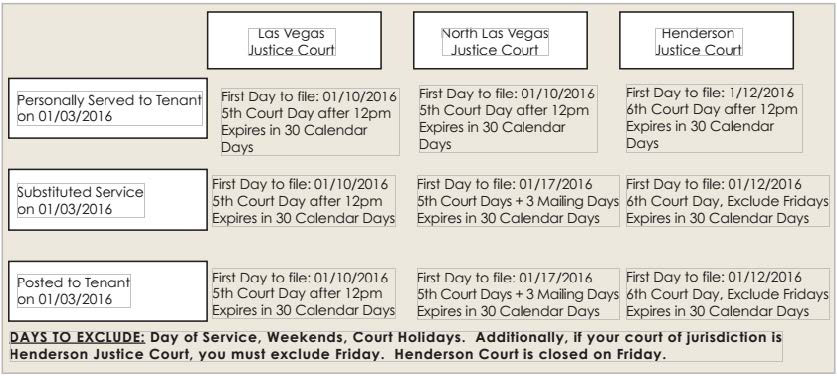
    There is no grace period on a 5 Day Pay or Quit, meaning that landlords can proceed with service of the notice the day after the rent is due. (However, if the particular lease and/or agreement between landlord and tenant allows for a grace period, then the landlord cannot proceed until that time has passed.) If a tenant does not file an answer and/or comply with the notice, the landlord can proceed to eviction/lockout filing after the fifth judicial day (excluding service day, court holidays, and weekends).

    It’s important that landlords understand what constitutes rent and the fees that can be included in a 5 Day Notice to Pay Rent or Surrender Premises:

    Rent refers to the money a tenant pays every period to live on the rental property, plus any late fees as stated in the lease agreement (NRS.118A.150). The amount calculated as rent does not include court costs, collection fees, attorney’s fees, returned check fees, unpaid security deposits, etc. (NRS 40.253[9]). Therefore, a landlord cannot refuse rental payment because court costs, attorney’s fees, etc., are not remitted.

    Notices for the alternative: Violations of lease agreements / Nuisance

    (Please note: These notices all require service of the Five Day Unlawful Detainer Notice)

    Five (5) Day Notice for Violation of Lease Agreement or Quit (NRS 40.2516)

    This notice is used by landlords who wish to evict a tenant who has violated the lease agreement in some way other than being a nuisance. This notice must advise the tenant of the violation and reference the portion of the lease that is being violated.

    Five (5) Day Unlawful Detainer Notice

    Five (5) Day Unlawful Detainer Notice – This is a mandatory 2nd notice that must be served under Summary Eviction protocols when evicting a tenant for a reason other than non-payment of rent. The Five (5) Day Unlawful Detainer Notice is to notify the tenant(s) that are in violation of the first notice served to them and the Eviction will be the next step if they do not comply.

    If the tenant does not remedy the violation and/or move out, then a 5 Day Unlawful Detainer Notice must be served before the landlord can proceed. The landlord can proceed to lockout after the fifth judicial day of service (excluding service day, court holidays, and weekends) of this second required notice.

    Three (3) Day Notice to Quit For Nuisance, Waste, Assignment/Subletting, Unlawful Business, or Drug Violation

    Nevada law (NRS 40.2514) allows a landlord to serve this notice to a tenant for reasons of nuisance. This notice requires a written reason(s) and/or description of the alleged nuisance.

    It’s important to note the law’s accepted definition of “nuisance“: “Conduct or an ongoing condition which constitutes an unreasonable obstruction to the free use of property and causes injury and damage to other tenants or occupants of that property or adjacent buildings or structures.” (NRS 40.2514[4]) Common examples of the alleged nuisance are:

    • Causing waste and/or damage to the rental property;
    • Unlawful business activity;
    • Improper assignment/subletting of the premises; and
    • Illegal drug use (NRS 453.011-552; excluding NRS 453.336).

    The tenant has three working days to fix the problem. If the tenant does not comply and/or file an answer, a second notice, the 5 Day Unlawful Detainer Notice (NRS 40.254) outlined above, must be served before the landlord can proceed. The landlord can proceed to eviction lockout after the fifth judicial day of service (excluding service day, court holidays, and weekends) of the 5 Day Unlawful Detainer Notice.

    No lease, or expired lease? We can help!

    Thirty (30) Day Notice to Surrender Premises

    This type of notice is used to evict a Nevada tenant by a landlord who desires the leased property back for any reason. This notice pertains to tenants who do not have a lease as well as tenants still living on the property after the lease has expired. This notice cannot be served if a lease agreement is still in effect. Contact LPS Eviction Service if you need to file a Thirty Day Notice to Surrender Premises.

    If the tenant does not comply with the notice and/or file an answer, a 5 Day Unlawful Detainer Notice, as outlined above, must be served before the landlord can proceed. The landlord can proceed to eviction lockout after the fifth judicial day of service (excluding service day, court holidays, and weekends) of the 5 Day Unlawful Detainer Notice.

    Examples of eviction process timelines for local courts
  • Small Claims

    Small Claims

    Legal Process Service (LPS) has provided the Las Vegas, Reno, and Carson City areas with professional service of process and assistance with small claims filings since 1982. Our small claims specialists are trained and ready to assist you with the small claims process both regionally and nationally. They can complete all documentation; oversee the filing of the small claims complaint, service of process, and filing of the affidavit of service; and assist you with processing your writ to collect on your judgment.

    The small claims filing process

    Small claims is a simple, effective collection tool when suing for amounts up to $10,000.00. At LPS, our experienced staff is able to guide you step-by-step through the entire small claims process. 

    The small claims courts are a division of the Justice Court system. In most small claims proceedings, applicable parties (the person bringing the suit is the plaintiff, and the party being sued is the defendant) will represent themselves, “pro se” or “in proper person.” Attorneys can represent either party in a small claims case; however, attorney fees are not recoverable from the losing party. Judges in small claims court can only order the other side to pay money. So if you hire an attorney to represent you in small claims court, you are personally responsible for attorney fees.

    When considering a small claims filing, ask yourself the following questions:
    • Is it worth my time and money? 
      Although small claims is a quick and inexpensive process, it’s not free. If the court sets a hearing date, you or someone who represents you will need to appear at that hearing. You should also consider the costs involved with preparing, filing, and serving your small claims documents. 
    • Am I seeking only monetary compensation? 
      The purpose of small claims is to reclaim a monetary value. The court cannot require an individual or business to return property (such as a lawn mower lent to a neighbor or the family pet kept by your ex) or to stop or start an action (such as allowing their dog to constantly bark in the middle of the night or removing an unsightly yard ornament). 
    • How much should I sue for? 
      You need to think carefully about this, as the judge will ask you to provide proof that you are entitled to the amount you claim. 
    • Is my claim for less than $10,000.00, or am I willing to settle for the small claims maximum of $10,000.00? 
      You can sue for a maximum amount of $10,000.00 in small claims court. If your claim exceeds $10,000.00, you may wish to consult with an attorney to file a formal lawsuit against the defendant(s). Or, you may wish to settle for the maximum amount allowed in order to sue through small claims court. However, you are not able to divide a claim into two or more claims in order to fall within the monetary limit. 
    • Have I attempted to resolve the issue without involving the court? 
      If you feel you have given the defendant(s) every opportunity to settle without involving the court, you have the option of suing through small claims.
    • Do I have sufficient evidence to support my case? 
      You may be required to show the court proof as to why you feel you are owed the amount you are suing for. 
    • How do I identify the defendant(s), and do I know their location? 
      You must use the company or individual’s legal name when naming a party in a small claims case. Businesses must be served at the address of the registered agent listed with Nevada’s Secretary of State. Individuals can be served at their residence or their place of employment/business. LPS has a skip trace department that may be able to assist with obtaining current addresses for individuals and/or businesses.
    • If I obtain judgement, do I have the required information to collect on my judgment?
      The ultimate goal of filing in small claims is to collect the amount you’re suing for. If you don’t have enough information to collect, you may need to file a Motion for Examination of Judgment Debtor with the court, which must be personally served to the defendant(s). This motion requires the defendant to show up at court and provide the court and you the requested information, which is usually a list of any assets they have through which you may be able to collect your judgment. 

    LPS’s small claims service in Nevada

    Although LPS can’t provide legal advice regarding small claims, our staff can take your small claims case from beginning to end, making the process as quick and as simple as possible for you. We will prepare the necessary case documents, file with the court of jurisdiction, and then serve the small claims document; all that is left is for you to show up at the hearing to present your case.

    LPS can draft many of the documents involved in the small claims process, including the demand letter, small claims complaint, Motion for Examination of Judgment Debtor, Writ of Execution, and Satisfaction of Judgment. Our prompt service of process includes a notarized affidavit.

    Once a judgment has been rendered, and upon your request, we can proceed with execution of the judgment. A writ can be prepared and filed to record and/or satisfy a judgment by executing upon a judgment debtor’s wages, real property, bank account, or cash box. Contact your LPS small claims specialist for assistance with execution of judgment. 

    If you qualify for any of the following, it’s important that you let LPS know, as this information must be notated on your small claims complaint as filed with the court:

    • Cases arising under NRS Chapter 604A (“Payday Loans, Deferred Deposit Loans, High-Interest Loans, Title Loans, and Check-Cashing Services”)
    • Cases arising under NRS Chapter 97A (“Bought/Sold Credit Card Debt / Debt Evidenced by Credit Card”)
    • Cases filed by inmates against the Nevada Department of Corrections
    • Cases filed by inmates against any party other than the Nevada Department of Corrections
    • Understanding the small claims process

      STEP 1: Send a demand letter

      • Identify the defendant you are suing and the amount of the suit.
      • Send a demand letter (certified, return receipt requested): The letter must state 1) the amount of money owed or being sought; 2) the reason for the suit; 3) that the recipient of the letter has 10* days from receipt of letter to respond or a civil action will be filed with the court. Click here if you would like LPS to process your demand letter.
        *Henderson Justice Court requires a 15-day window for response.  
      • If there is no response to the demand letter, contact your LPS small claims specialist to begin your new case filing. Click here to get your small claims case started. 

      STEP 2: Legal action and court fees

      Upon completion of the small claims documents, filing fees must be tendered to the Justice Court of jurisdiction. Jurisdiction is determined according to where the proposed defendant lives, works, or does business.
      In order to get your case heard in small claims court, a fee must be paid to the court to open your case. Filing fees are determined by amount of the claim or lawsuit as follows:

      • If the sum claimed does not exceed $1,000.00, the court filing fee is $66.00 
      • If the sum claimed exceeds $1,000.00, but does not exceed $2,500.00, the court filing fee is $86.00 
      • If the sum claimed exceeds $2,500.00, but does not exceed $5,000.00, the court filing fee is $106.00
      • If the sum claimed exceeds $5,000.00, but does not exceed $7,500.00, the court filing fee is  $146.00
      • If the sum claimed exceeds $7,500.00, but does not exceed $10,000.00, the court filing fee is $196.00

      STEP 3: After filing

      FOR NORTH LAS VEGAS, HENDERSON, RENO, SPARKS AND CARSON CITY JUSTICE COURTS ONLY

      Once the case has been filed, it will be assigned a tentative hearing date. The defendant must be served with a copy of the small claims complaint within ten (10) calendar days of the hearing date. This service may be take place at either the defendant’s residence or place of employment/business; however, if the defendant is served at their place of employment/business, personal service is required.
      Once the defendant has been served, the affidavit of service along with a memorandum of costs and disbursements must be filed with the court in a timely manner to confirm your case on the calendar and to notify the court of the costs incurred processing your complaint. A decision will be rendered by the court at the hearing. 

      STEP 4: Finalizing the judgment

      Once judgment is received, you can collect it by filing a writ of execution. A judgment is valid for six years and can be renewed for another six years as many times as necessary until the judgment is paid.
      There are various types of writs; however, only one writ at a time is allowed per judgment. Learn more about the writs below and click here to submit your request for a writ of execution.

      1. Garnish Wages
        This takes a recurring deduction from the defendant’s wages for up to 120 days. You must have the defendant’s employment information (please include the social security number and/or department, if known). This will claim only an allowed amount from the defendant’s paycheck; if the total amount of the judgment is not collected within the 120 days, another writ will need to be processed. 
      2. Lien Property
        This places a lien on property owned by the defendant. This is a one-time filing and you must know the APN number for the property. Once the property is sold, an amount up to the total judgment amount is deducted from the sale and provided to you. If the property is not sold within 6 years, you will need to renew your judgment and rerecord the lien. 
      3. Levy Bank Account
        This is a one-time filing and you must know the defendant’s bank account number, bank branch, name, and address. An allowed amount up to the judgment amount is deducted from the bank account; however, if the judgment isn’t satisfied with that bank levy, another writ will need to be processed. 
      4. Levy Cash Drawer
        If the defendant is a business, you can file a writ for a cash drawer levy / till tap. This is a one-time filing where an amount up to the total judgment amount is removed from the cash drawer, till, safe, tip jar, etc. If the judgment isn’t satisfied with that levy, another writ will need to be processed. 
      5. Lien Vehicle
        If the defendant owns a vehicle, you can file a writ to place a lien on it. You must have a full description of the vehicle including make, model, and serial number, as well as its location. You must also have a printout from the Department of Motor Vehicles at the time the execution is filed.
        The vehicle will be held by the constable’s office for 10 days to give the defendant a chance to pay the judgment in full. If the defendant doesn’t pay the judgment in full, the constable will set the vehicle for auction and notify you of the time and date of auction. You may attend the auction and bid on the vehicle.
        This is a one-time filing where an amount up to the judgment is deducted from the amount received from the sale of the vehicle; if the judgment isn’t satisfied, another writ will need to be processed. 

    • What clients ask about the small claims process


      Can I file in the court that is closest to me?

      The court rules dictate that your complaint should be filed in the Justice Court of the township where the defendant(s) currently reside, does business, or is employed. If you file in the wrong court, you risk the chance that the judge may dismiss your case. Similarly, the defendant can petition the court to dismiss based on the wrong court of jurisdiction. 


      What if I want to sue for more than $10,000.00? 

      You can choose to settle for the maximum amount allowed in small claims court, or you can contact an attorney to file a formal lawsuit.


      What if I don’t know where to serve the defendant(s)? 

      LPS has a skip trace department that may be able to obtain a more current service address for the defendant(s). 


      Is there an alternate method of service? 

      Small claims court does allow for service by certified mailing, however, this allowance must be approved by the court.


      Will a representative from LPS be at my small claims hearing? 

      Unfortunately, no. This is the only part of the process that we cannot assist you with.


      Am I entitled to recoup the fees that were paid to LPS if I win my case? 

      This is completely up to the judge. Should you win your case, the judge can add up to 100% of LPS fees and your filing fee to the amount you are suing for. 

  • Nationwide Process Service

    Nationwide Process Service

    Legal Process Service (LPS) has specialized in consistent, top-quality service of process since 1982. Our staff and process servers are knowledgeable, professional, and completely dedicated to providing you with the best experience. We want to make your job easier by proving ourselves as your best source for service of process nationwide.

    Dependable nationwide service of process

    Over the years, LPS has cultivated a roster of preferred vendors throughout the country. We work with these vendors because they exemplify the same level of commitment and professionalism that we take pride in at LPS.

    These interstate personnel handle your services in a timely and cost-effective manner. LPS will handle your requests to completion, promptly providing updates and copies of affidavits. We want you to be at ease, knowing your request is our priority.

    Pushing to meet a deadline? Rush out-of-state services are our specialty!

    We serve all U.S. states and territories:
    • Alabama
    • Alaska
    • Arizona
    • Arkansas
    • California
    • Colorado
    • Connecticut
    • Delaware
    • District of Columbia
    • Florida
    • Georgia
    • Hawaii
    • Idaho
    • Illinois
    • Indiana
    • Iowa
    • Kansas
    • Kentucky
    • Louisiana
    • Maine
    • Maryland
    • Massachusetts
    • Michigan
    • Minnesota
    • Mississippi
    • Missouri
    • Montana
    • Nebraska
    • Nevada
    • New Hampshire
    • New Jersey
    • New Mexico
    • New York
    • North Carolina
    • North Dakota
    • Ohio
    • Oklahoma
    • Oregon
    • Pennsylvania
    • Rhode Island
    • South Carolina
    • South Dakota
    • Tennessee
    • Texas
    • Utah
    • Vermont
    • Virginia
    • Washington
    • West Virginia
    • Wisconsin
    • Wyoming
    • American Samoa
    • Guam
    • Northern Mariana Islands
    • Puerto Rico
    • U.S. Virgin Islands
  • Service Handling

    LPS offers four types of service handlings:

    • Routine (7-10 days) 
    • Business Routine (2-3 business days)
    • Priority (48 hours)
    • Immediate (same day/24 hours)

    All LPS service fees (with the exclusion of time and mileage service requests) include multiple attempts, weekend attempts at no additional charge, notarized affidavits, and timely updates. 

    LPS also offers “on demand” and specialty service handlings:

    • Arranged/surprise meetings
    • Stakeouts
    • Evasive individuals
    • Convention services
    • International services

    Fees for specialty services are quoted upon request.

  • International Process Service

    Legal Process Service (LPS) has provided professional, top-quality service of process since 1982. We want to be your one stop for service of process, and we specialize in getting the best results at every level — local, national, and international.

    Over our decades in business, LPS has cultivated a roster of preferred vendors all over the world with whom we serve papers internationally. Our International Services Department strives to get your service completed as promptly, efficiently, and economically as possible. You get timely electronic status updates throughout the process and at completion of service.

    LPS prides itself on quality service of process and follows strict adherence to your state’s codes of civil procedure. 

    International locations we have served

    https://www.google.com/maps/@0,0,28165806m/data=!3m1!1e3?hl=en-US&entry=ttu&g_ep=EgoyMDI1MDkyNC4wIKXMDSoASAFQAw%3D%3D

  • Skip Tracing

    Skip Tracing

    Why choose LPS for your skip tracing?

    Our skip-tracing specialists are dedicated to providing excellent service and proven results in Las Vegas, Reno, Carson City, and the surrounding areas. We are highly successful in locating defendants, witnesses, and other individuals or entities.

    It can be complicated to complete a thorough skip trace in Nevada. Courts of jurisdiction will often require that a diligent effort be made to locate an individual before an order for alternate service of process will be granted and/or a default judgment is secured. We understand these requirements, beginning on the local front and expanding the trace nationally as needed.

    Steps to a successful skip trace
    1. Our skip-tracing specialists must pass a thorough background check as required by our license.
    2. Please note we run skip traces only for reasons of due process. If you need a verified current address to effect service of process, submit your request for service to our skip tracing department.
    3. All new skip traces require a full set of the documents to be served, as well as any information you have on the specific individual or entity.
    4. We start by accessing the most extensive skip-tracing databases in the industry; our credentials qualify us to tap into a variety of sources including public records, real estate, business data, national cross directories, utilities, motor vehicle information, and much more. 
    5. We work diligently to validate any address before encouraging a client to incur fees for physical service.
    6. If a positive address cannot be confirmed, we will provide an affidavit of due diligence detailing our efforts to locate any current address, either personal and/or business.
    Our skip traces include the following categories of information: 
    1. Phone number databases
    2. Credit reports
    3. Credit card applications
    4. Public records databases
    5. Job applications
    6. Criminal background checks
    7. Loan applications
    8. Air travel records
    9. Driver’s license/vehicle registration departments
    10. Utility bills
    11. Public tax information
    12. Courthouse records
    13. Department store loyalty cards

    Please note that any information obtained during a skip trace is confidential and handled on a case-by-case basis.

  • Court Filing

    When law firms need to get court filings done and conformed copies returned quickly, the smart choice is Legal Process Service. We move legal documents with speed and accuracy using our proprietary electronic file & serve system. Our meticulous document specialists inspect, upload, and file your legal documents with the court jurisdiction of your choice, typically on the same day the order is placed. Even better, the average conformed copy is returned by 12 p.m. the next business day and can be retrieved directly from your email inbox. How’s that for speed and convenience?

    Common legal documents we file 
    • Summons
    • Complaints
    • Petitions
    • Answers
    • Motions & proposed orders
    • Dismissals
    • Defaults
    • Proof of service

  • eFiling

    Because LPS is a court-approved Electronic Filing Service Provider (EFSP), you can trust that we’re compliant with all current eFiling standards. Our electronic file & serve system enables both attorneys and legal support staff to quickly place a request for eFiling, easily manage cases and corresponding documents, and retrieve conformed copies and Proof of Service anytime.

    Counties we serve: 
    • Clark
    • Nye
    • Washing
    • Humboldt
    • Elko
    • Lincoln
  • Court Services

    Court filings – at window 

    When law firms need to get court filings done and conformed copies back quickly, the smart choice is Legal Process Service (LPS). We will assign a dedicated runner to your filing request and will handle your filing “at window.” Prompt updates are provided and conformed copies returned electronically. LPS can assist with court filings anywhere in Nevada and the United States. 

    eFiling – Nevada

    LPS will move your legal documents with speed and accuracy through the eFiling system used by Nevada courts. Our staff will promptly submit all eFiling requests, remit fees, and provide conformed copies electronically. The ease and timeliness of this service is a plus for many of our busy clients. 

    County recordings 

    LPS personnel can help with recordings such as real property or land documents (i.e., deeds, quit claim deeds, deeds upon death, grant bargain sales, trustee deeds, etc.) as well as other types of documents (abstracts of judgment, mechanic’s liens, notices of non-responsibility, etc). We will provide information on recording fees and county requirements, as well as a dedicated runner to handle your recording “at window.” You’ll get a prompt electronic update with recording confirmation. 

    LPS can also offer assistance with recordings on a national basis. 

    Court and county recorder record searches 

    LPS’s standard procedure for court record searches begins with retrieval of the case docket sheet and/or register of actions. You’ll get a detailed list of documents filed to the case that you can carefully review and request copies. We’ll handle your copy requests in a timely manner and bill you for the fees and copies accordingly.

    A similar procedure is followed with county recorder searches. Some of the most common and requested types of record searches are for marriage licenses / abstract of marriage recordings, divorce decrees, judgments, mechanic’s liens, etc.

    Please click here for assistance with a records search.

  • County Recording

    County Recording

    We take the guesswork out of county processes

    Need a document recorded, but not sure what the county recording requirements are? Or maybe you just don’t have the time to get it done? Whatever the reason, with Legal Process Service, you have extensive county recording services at your fingertips.

    We record legal documents on a daily basis throughout Nevada’s 16 counties and across the country. We can even retrieve documents for you from any County Recorder’s archival database in the state.

    Common legal documents we record
    • Abstract of judgment
    • Federal or state tax lien
    • Judgment
    • Mechanic’s lien
    • Notice of lis pendens
    • Notice of trustee sale
    • Deed of trust